
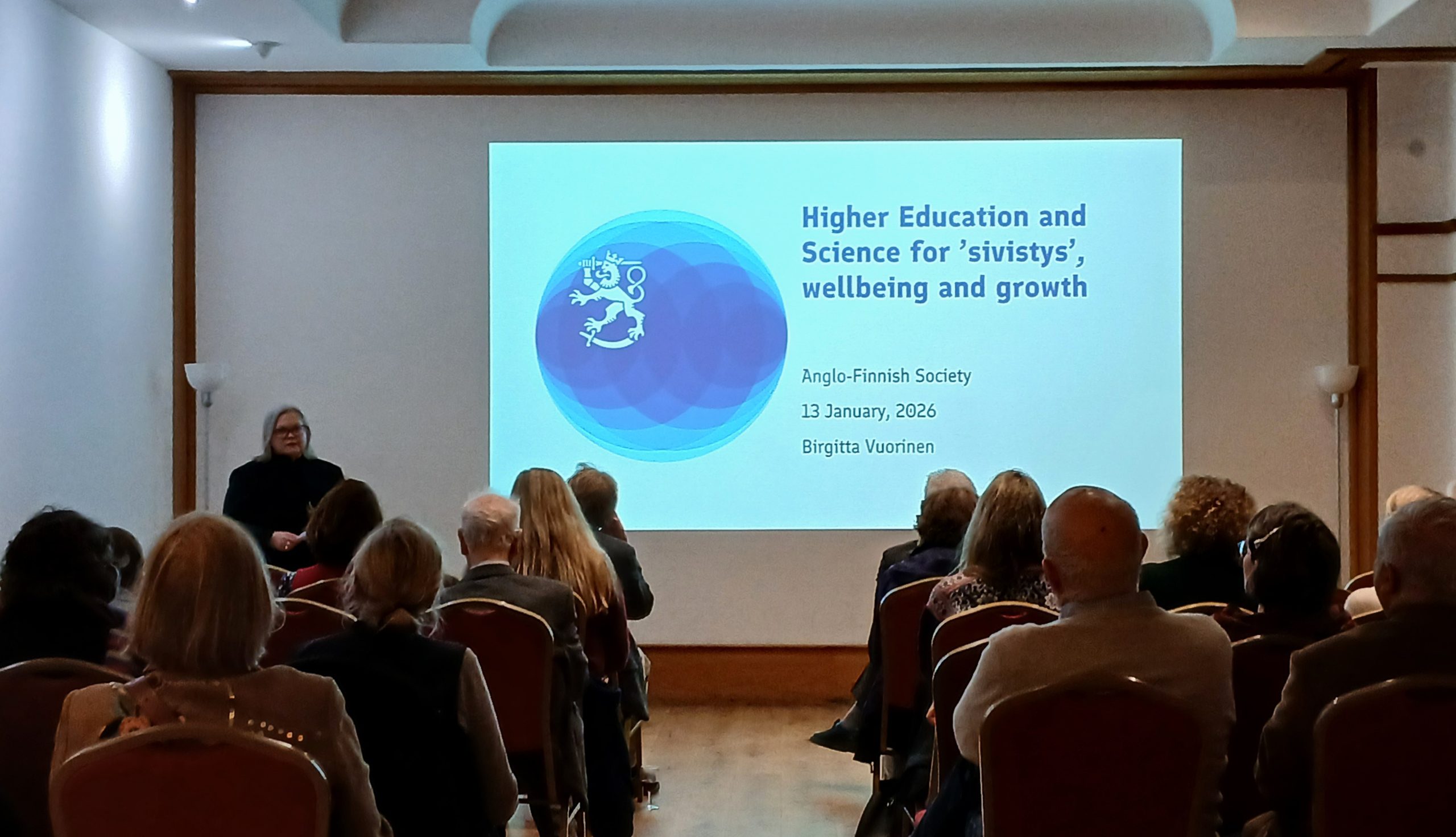
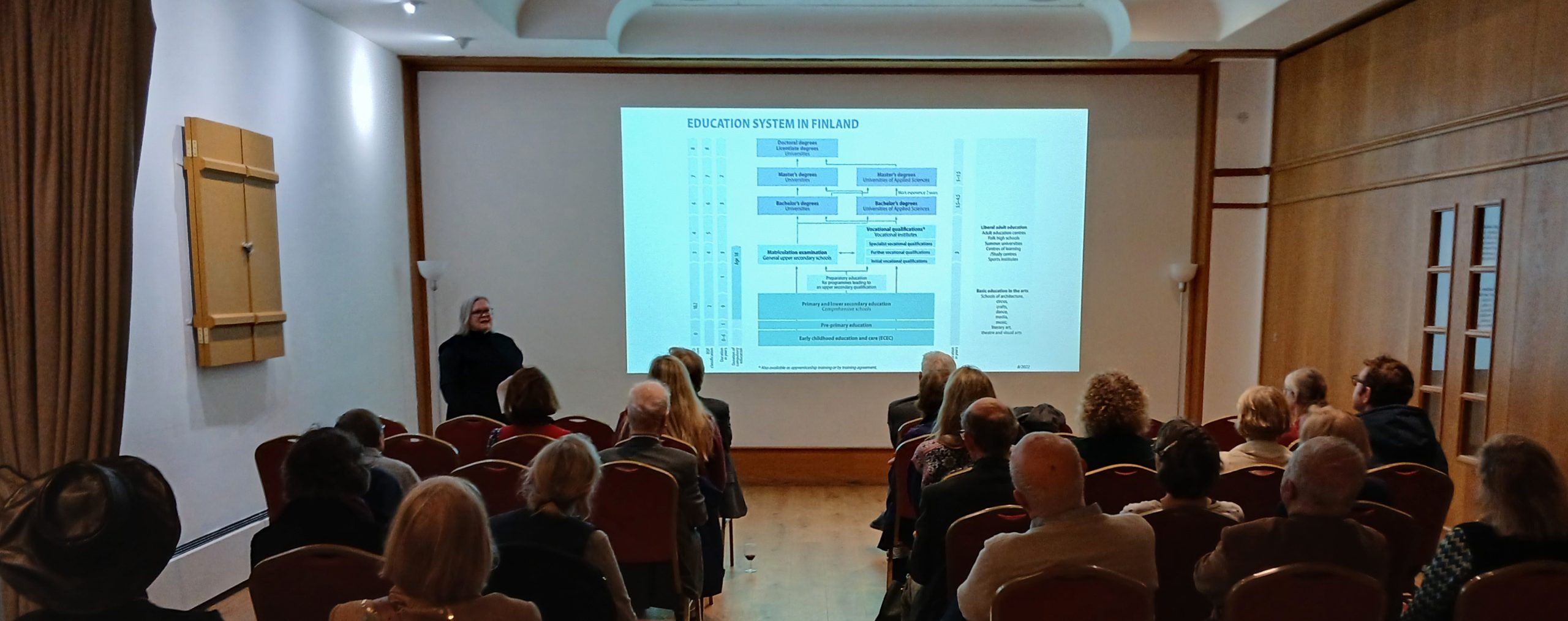
On 13 January 2026, we were given a talk on Higher Education in Finland: A strategic look at its role in the Education system and what can be learned from higher education policies in the UK by Birgitta Vuorinen, Counsellor, Education and Science, Embassy of Finland, London.
Finland is known for its high-quality education system striving for educational equity, equality and excellence, at all levels. Finland invests in building a strong foundation for learning in early childhood education and care, offers inclusive comprehensive education as well as upper secondary general education and VET, which both give eligibility for degree studies either at academically oriented universities or professionally oriented universities of applied sciences.
A well-functioning education system has been crucial in transforming Finland from a poor war-torn nation to a prosperous, innovative society in a relatively short time. Today, Finland is renowned as one of the most innovative economies in the world.
Birgitta Vuorinen talked about the role of higher education, research and international cooperation in these fields in today’s Finland. She also shared her view on the UK’s higher education and research policies Finland could learn from.
About Birgitta Vuorinen
Birgitta Vuorinen joined the Embassy of Finland in London in 2022 as Counsellor for Higher Education and Science. She relocated to London from the Finnish Ministry of Education, Science and Culture, where she had worked in various roles since 1995. Her latest position at the Ministry was Director of Higher Education Policy Unit (2019-2021), before that she was Head of the Group for Government Key Projects (2016-2018). In her roles she has been involved in European policy making in the context of the Nordic Council of Ministers, European Union and Bologna Process.
In London, her task is to follow higher education and science policy in the UK, foster opportunities for cooperation, promote Finland’s visibility, and assist Finnish higher education institutions, research institutes and other innovation ecosystem stakeholders in their endeavours for closer cooperation with British parties.
Birgitta Vuorinen belongs to Team Finland Knowledge Network which consists of eight higher education and science experts stationed in seven countries and eight cities: Beijing, London, Los Angeles, New Delhi, Pretoria, São Paulo, Singapore and Washington. All experts work in Finnish missions abroad.
Birgitta Vuorinen graduated from the University of Jyväskylä in 1995 with a Master’s Degree in Educational Sciences.
Patrick Salmon, Chief Historian at the Foreign, Commonwealth and Development Office and A-FS Council member gave an insightful talk on Churchill’s Baltic Vision in the Allen Room on 17 February 2026. As Patrick explained, Winston Churchill never visited the Baltic, but it held an important place in his strategic imagination at key points in his long career in politics. In both world wars, he dreamed of inflicting a dramatic defeat on Germany via Scandinavia and the Baltic. After the Russian Revolution he hoped to defeat Bolshevism in partnership with Finnish General Mannerheim. Patrick asked the question as to whether any of these ambitions could have been achieved. With perceptive analysis he explored the strengths and limitations of Churchill’s Baltic Vision.
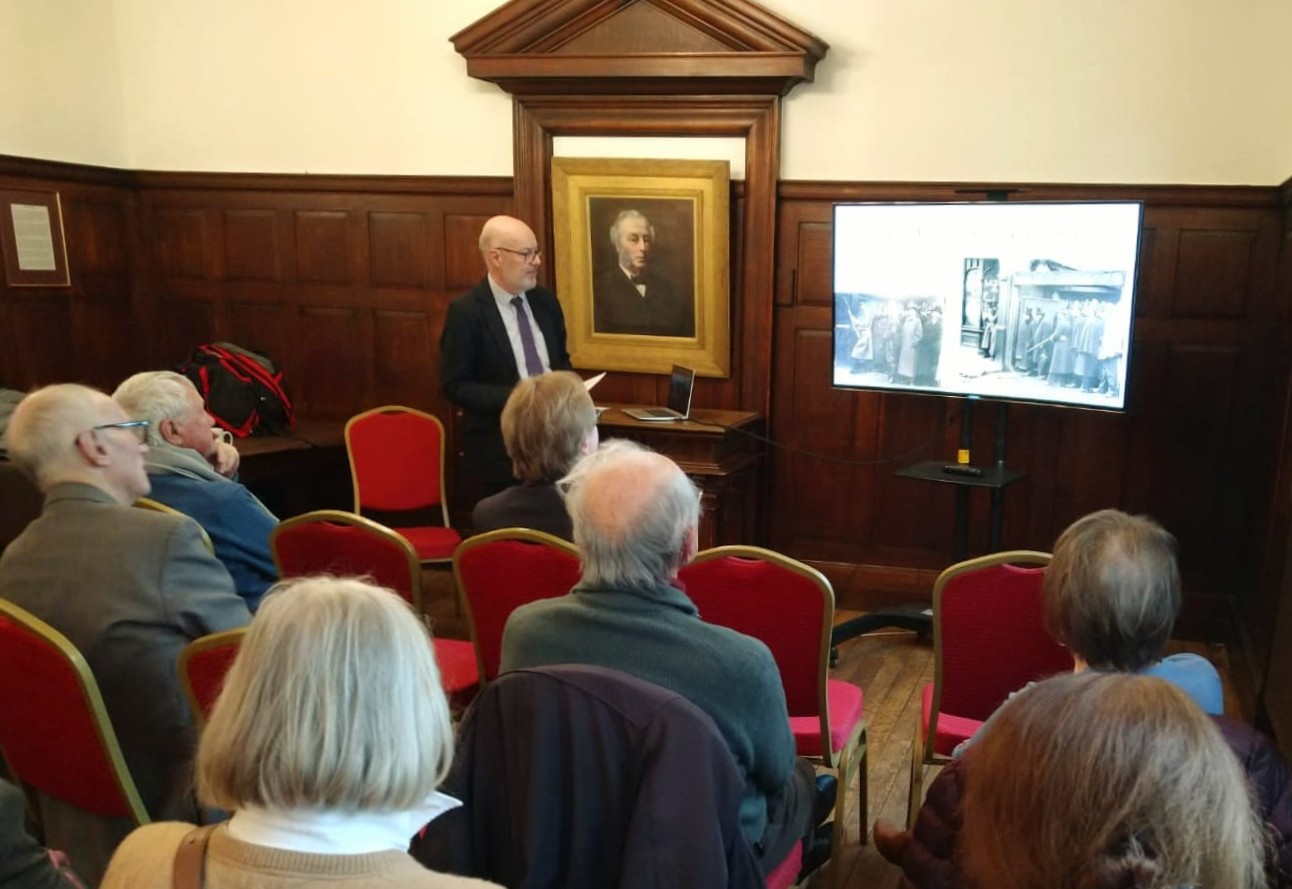
Patrick Salmon has published extensively on Scandinavian and Baltic history, including Scandinavia and the Great Powers 1890-1940 (1997) and Deadlock and Diversion: Scandinavia in British Strategy during the Twilight War 1939-1940 (2012). Patrick has been a member of the A-FS Council since 2017.
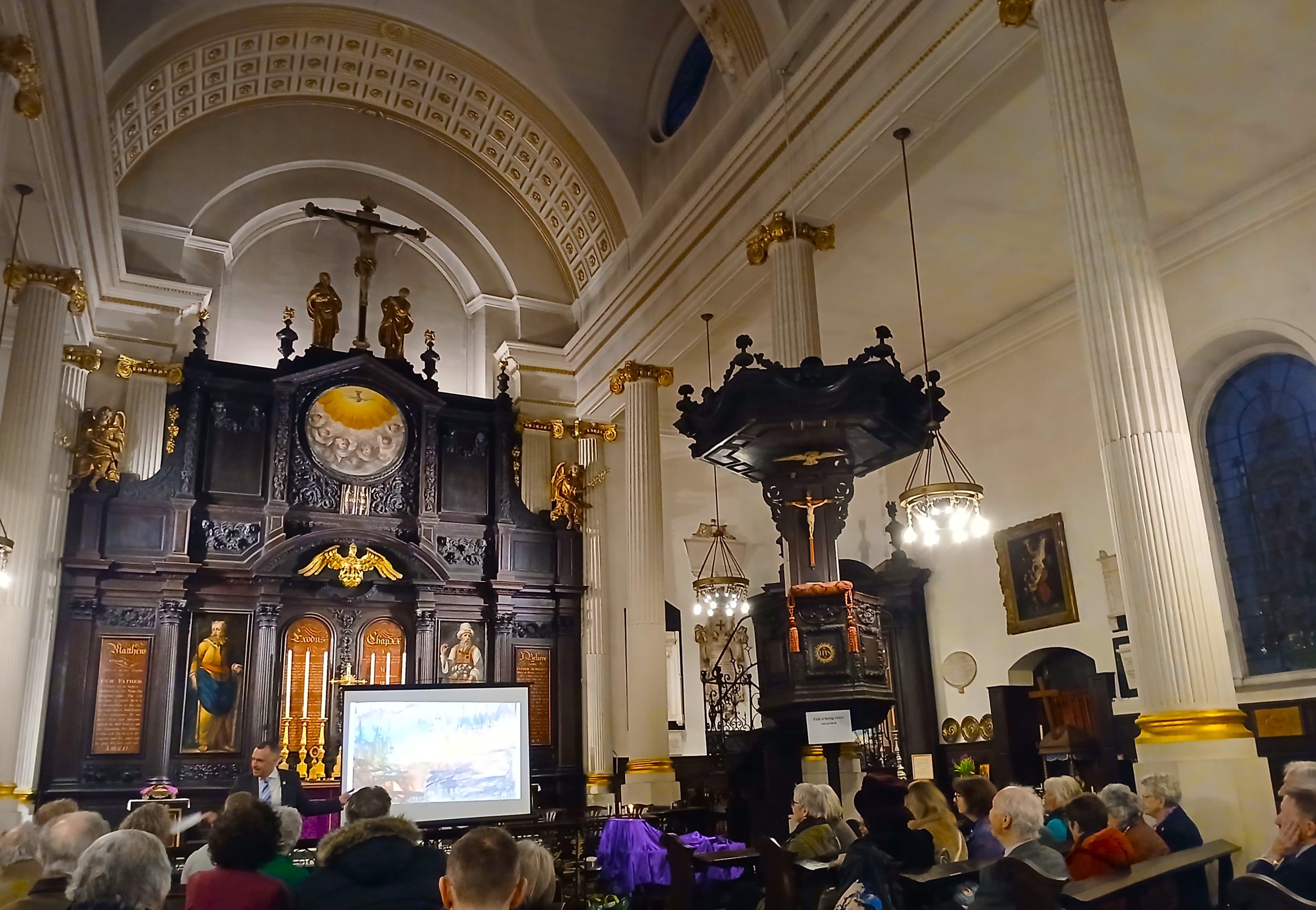
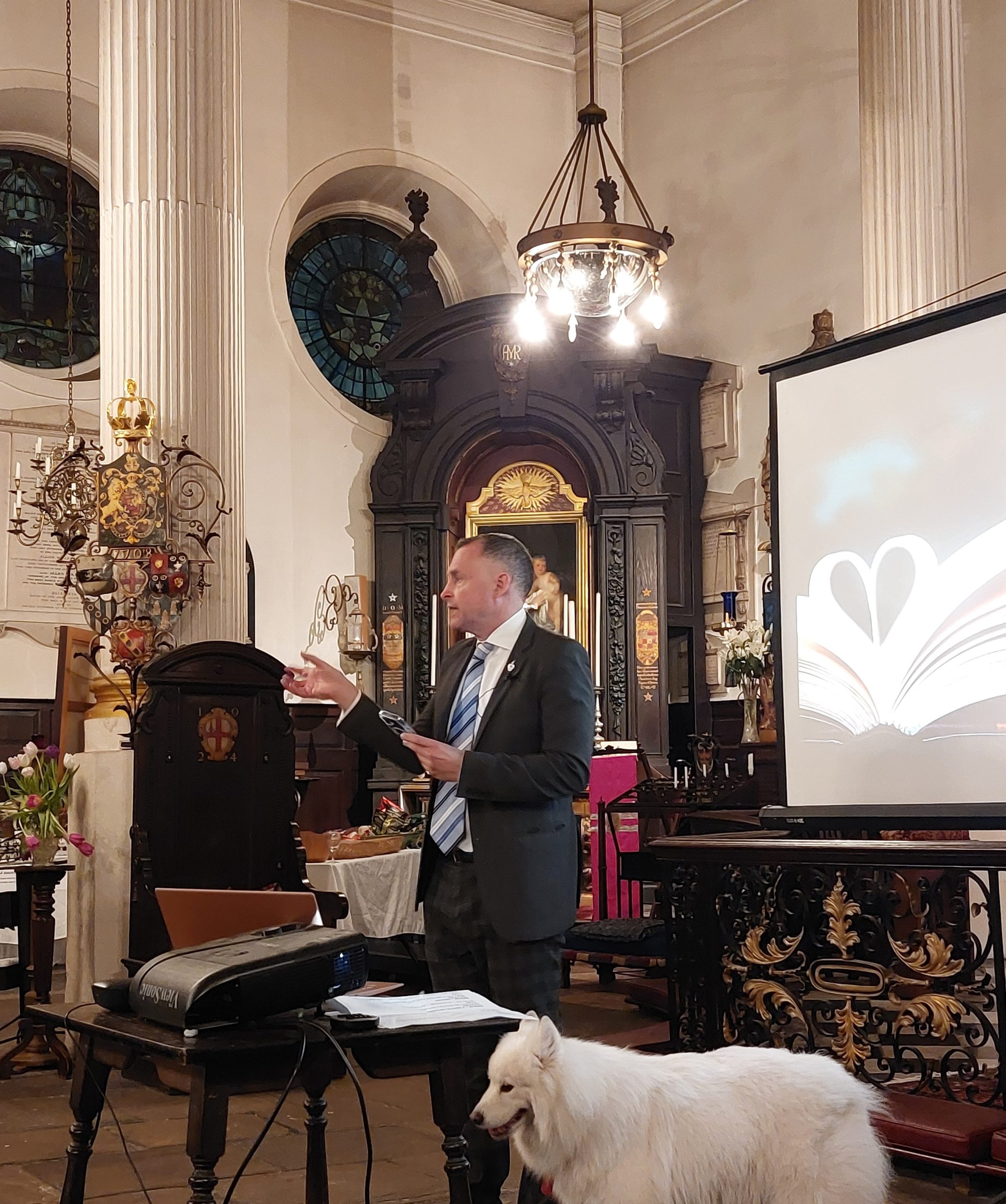
On 9 March 2026, David Pearson gave a talk on “Forging Kalevala in Music: Inside a Composer’s Creative Process” at the Church of St Magnus the Martyr, London Bridge.
We were offered a rare chance to witness how music is created in real time. Composer David Pearson shared how he is approaching Finland’s national epic, Kalevala, as the foundation of a four‑opera cycle — a project echoing the scale and ambition of Wagner’s Ring. He discussed the challenges and discoveries involved in:
– shaping a libretto from a vast and symbolically rich poetic source
– navigating the complexities of Kalevala Finnish
– interpreting the mythic and archetypal layers of the text
– structuring a monumental narrative into four coherent operas.
The talk included musical illustrations and a live view of the composer’s working drafts, textual analysis and score materials.
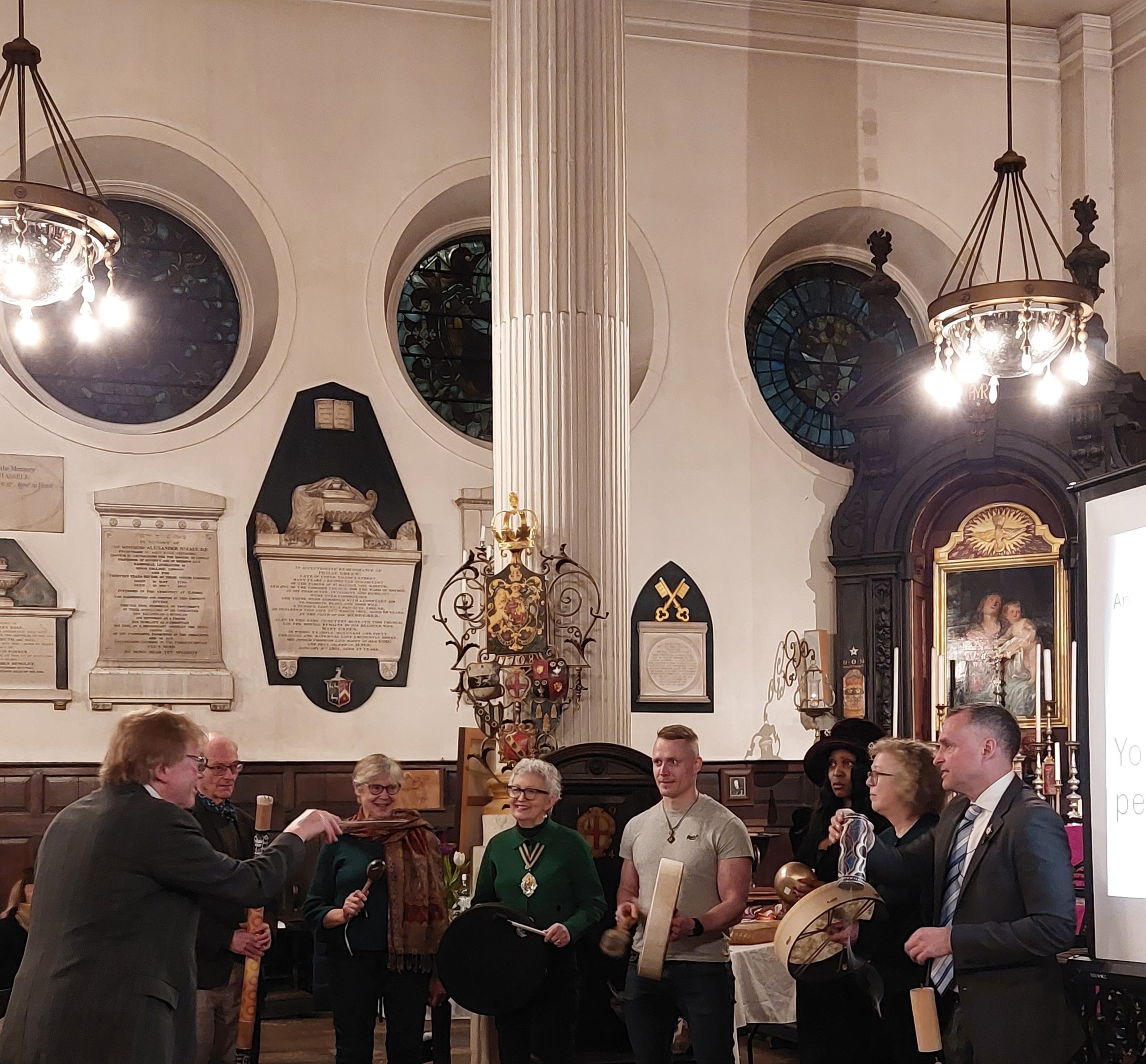
The setting was the historic Grade I listed Church of St Magnus the Martyr, one of Sir Christopher Wren’s finest post-fire churches. Its Nordic connections run deep – St Magnus was Earl of Orkney when the islands formed part of the Kingdom of Norway. We could also enjoy the church’s magnificent, world-famous model of medieval London Bridge.
David’s background is in economics, corporate finance, culture change and leadership, but he has also studied music, and together with his interest in Finnish cultural history, this has inspired him to take on the task of setting Kalevala in music. He also manages to find the time to act as the A-FS Treasurer.
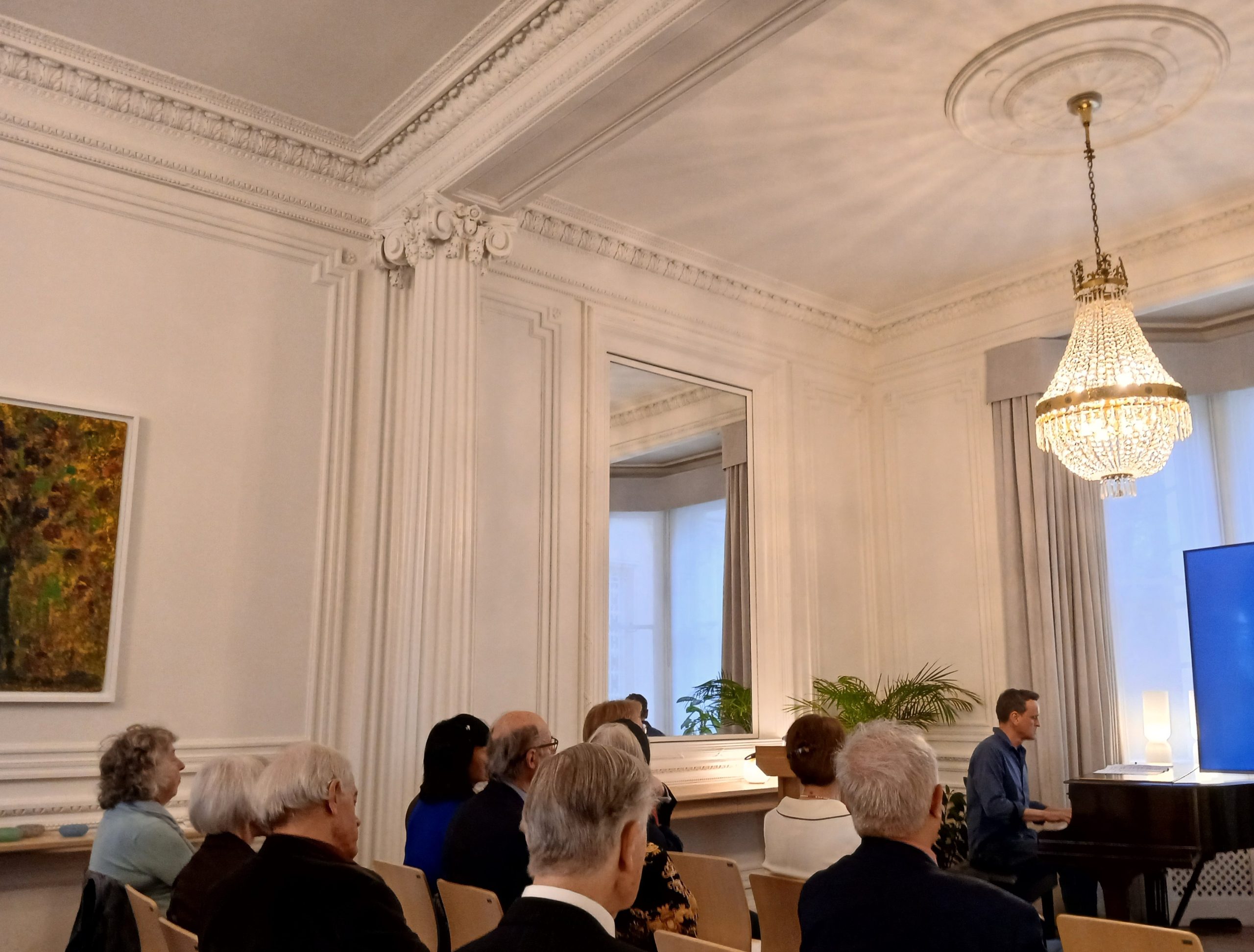
On 14 April 2026, our AGM took place again at the Finnish Residence in Kensington Palace Gardens. We remain grateful to H.E. The Ambassador of Finland, Mr Teemu Turunen, Hon. President of our Society, for hosting us with a convivial reception after the AGM. We also heard our Member Olli Cunningham play on the grand piano one of his beautiful compositions Beauty Awakens from his album Preludes which was released last year on 27 November 2025..
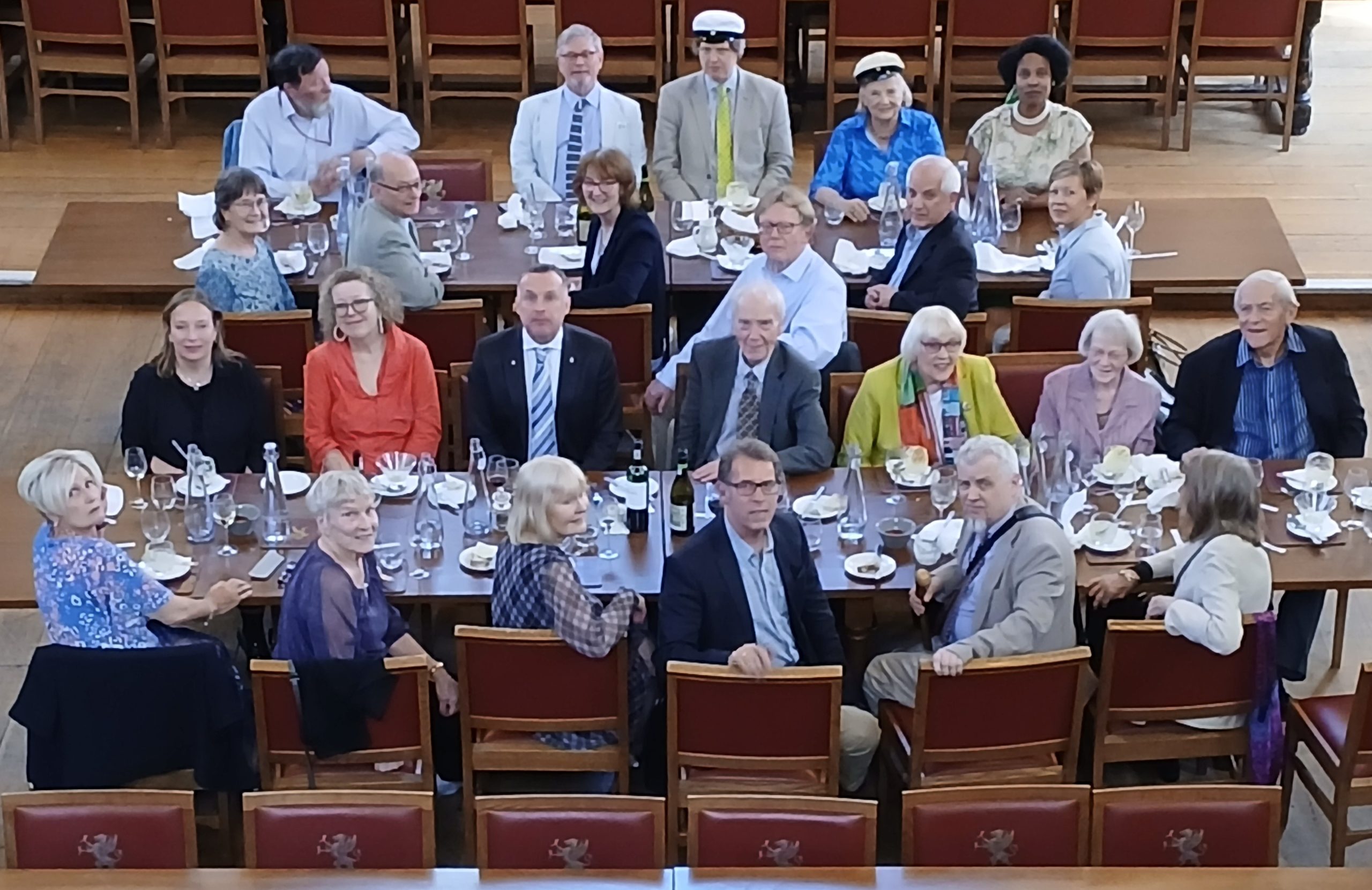
On 1 May 2026, we had our Vappu-Valborg lunch at Gray’s Inn for a second year running. We also had a guided tour of the surprisingly extensive collection of art at Gray’s Inn by Timothy Shuttleworth, Bencher of Gray’s Inn. It was also a beautiful sunny day. (For more photographs see our Facebook and Instagram pages.)
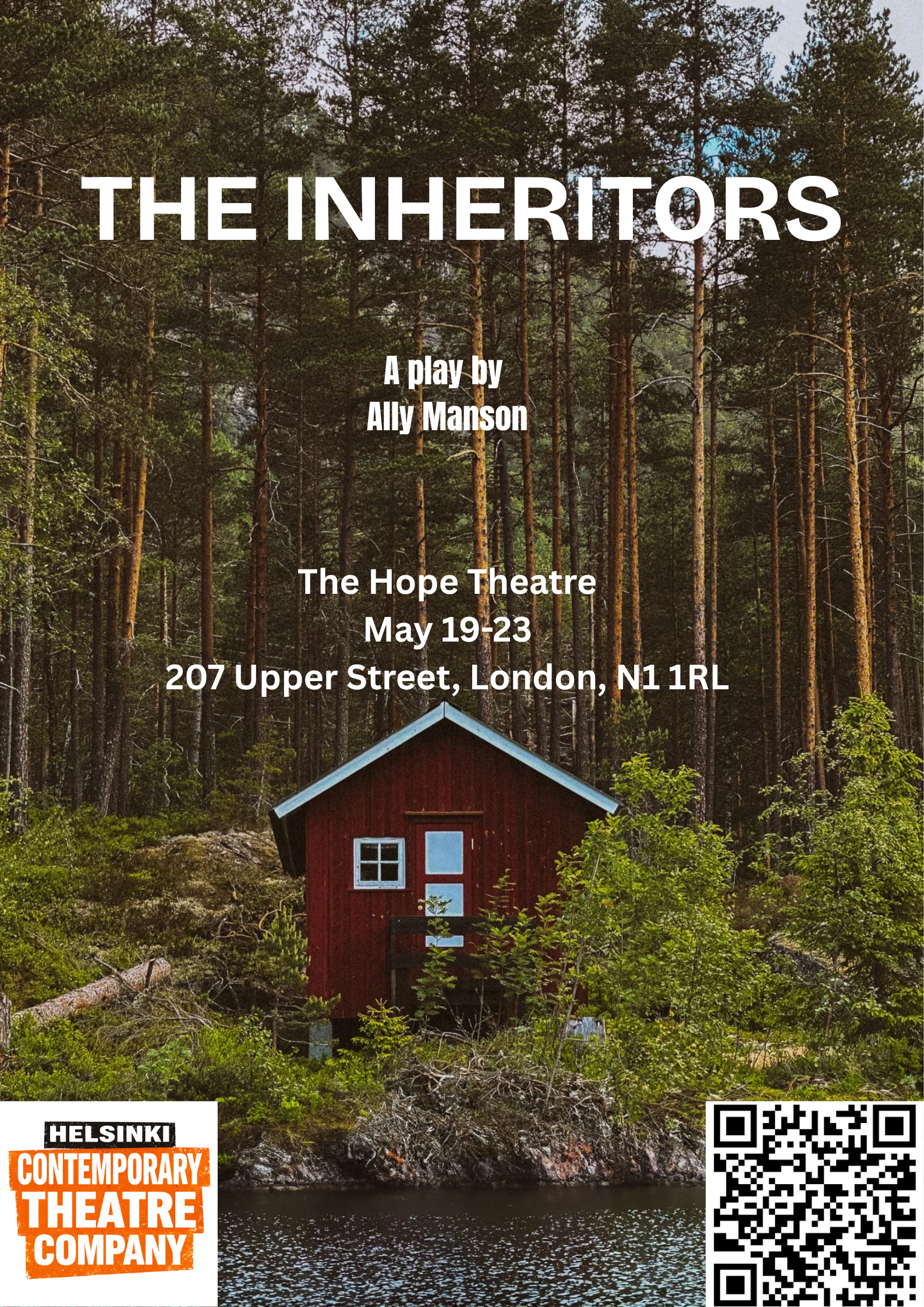
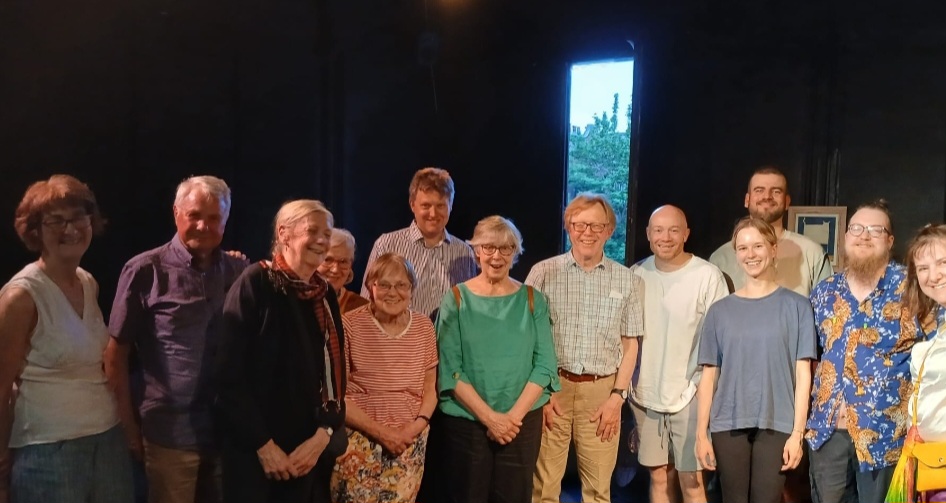
On 22 May 2026 we organised a post-performance Q&A of the penultimate show of The Inheritors by Helsinki Contemporary Theatre Company at The Hope Theatre, The Hope and Anchor, in Islington, London.
The Play
Following a successful run in Helsinki in 2025, Helsinki Contemporary Theatre Company transferred their inaugural production to London. The Inheritors is a contemporary three-hander that explores the messy terrain of familial legacy, guilt, and the burdens inherited from parents. When three siblings reunite at the family Mökki (summer lake cottage) to divide up their father’s estate, long-buried tensions resurface….. and what begins as a practical discussion turns into a reckoning with the past.
About Helsinki Contemporary Theatre Company
Founded in 2024, Helsinki Contemporary Theatre Company is an international, English-speaking theatre company based in Helsinki. The Company creates productions and workshops of new work and established plays. With its own productions, of which The Inheritors is its first, the Company seeks to be thought-provoking with themes that reflect the diverse voices and lived experiences of modern Finland. It aims to provide a platform for both local and international artists to collaborate.
By offering high-quality theatre in English, the Company is opening the doors of Finnish theatre to new audiences. It also runs acting classes for professional actors and amateurs who have an interest in learning. Whether it’s through performances, artist workshops, or community outreach, the Company is committed to expanding the theatrical landscape in Helsinki.
About the playwright - Ally Manson
Ally Manson is a UK-trained actor, with many acting and directing credits in UK theatre, film and TV, who is married to a Finn and is now living and working in Helsinki. He is the Artistic Director of Helsinki Contemporary Theatre Company and is behind its formation in 2024. And as a playwright, The Inheritors is his debut play.
Ally is an engaging character and has an interesting story. This might be the first play by an Englishman written and set in Finland and then brought to London. On 22 May we had the chance to meet him, giving us a talk and Q&A for our members and their guests at the end of the performance.
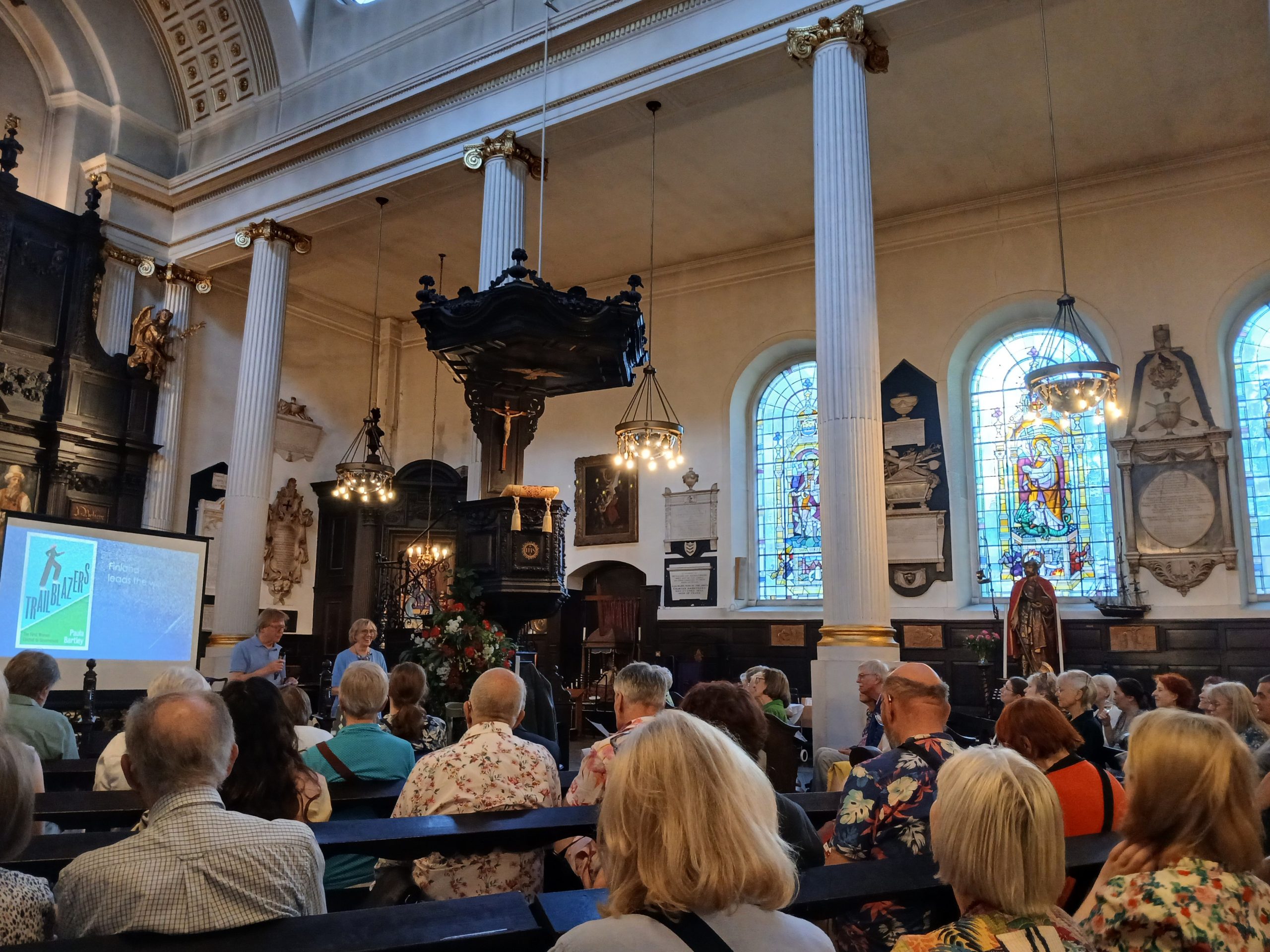
On 27 May 2026, we hosted a book launch for Trailblazers: The First Women Elected to Parliament at the Church of Saint Magnus-the-Martyr, London Bridge. In this talk to launch her latest book, Dr Paula Bartley revealed how Finland shook world politics, with Trailblazer Hilda Käkikoski.
Does it surprise you that Finnish women sparked a political fire that spread democracy across the world? At the beginning of the twentieth century, unless they were of royal blood, there were no women – not one – in any government, in any country, in any part of the globe. This was set to change.
In 1907, the country elected nineteen women to its 200 strong Parliament, the Eduskunta. These new female parliamentarians represented all social classes: from maids and factory workers to schoolteachers and noblewomen. One of those elected was Hilda Käkikoski, a lesbian, vegetarian feminist. Using images, Paula focused her talk on Hilda partly because she was intrigued to find out how and why such an unusual figure became one of the first women in the world to enter government.
Everything about Hilda Käkikoski shouted liberalism. She seemed very woke. Paradoxically, she stood as a Conservative candidate. She was a member of the Old Finnish Party (FP). This was a party which promoted the Finnish language and Finnish ideals.
Finland forged the path to an age of democracy. The twentieth century was marked by extensive global, social, technological and political transformations. Revolutions, two world wars, the Cold War, the decolonisation of Africa and Asia, the increasing power of America and the formation and collapse of the United Soviet Socialist Republic reshaped global politics. Women all over the world, at different times, in different jurisdictions and in different circumstances took advantage of the power vacuums created by these upheavals and demanded their rights to participate in governing bodies.
More and more countries adopted systems of government that gave citizens the right to vote and stand for government. In 2000, women were represented in most governments across the world. And it was Finland that trailblazed the way.
About the author and speaker
Dr Paula Bartley has been committed to women’s history since she began her teaching career. In 1982 she co-edited and co-authored the path-breaking series Women In History for Cambridge University Press. Since then, she has written The Changing Role of Women (1996), Emmeline Pankhurst (2002), Votes for Women (3rd edition, 2007), Ellen Wilkinson, (2014), Queen Victoria (2016), Labour Women in Power (2019), and Women’s Activism in 20th Century Britain (2022), Her latest book is Trailblazers: The First Women Elected to Parliament (2026).
Paula is currently Honorary Research Fellow, University of Warwick. She has been awarded prizes and grants from the Society of Authors, the British Association for Canadian Studies, the Harry Ransom Centre, Texas and Vassar College, New York to help further her research.
Paula loves talking about women’s history. She can be heard discussing Ellen Wilkinson, the Mighty Atom (parliamentary YouTube) and Queen Victoria (Historic Royal Palaces Podcast).
She is an active member of the Women’s History Network (WHN) and has organised many conferences and was a judge of WHN’s annual book prize.
Recently, thanks to a DNA test, Paula discovered she is 48% Scandinavian, mostly Norwegian. She lives in Stratford-upon-Avon with her husband Jonathan Dudley.
On Sunday, 7 June 2026, at Burgh House, Hampstead, London, we were delighted to support with a group of our members attending a sold-out concert of The United Kingdom Sibelius Society (“UKSS”) – a Summer Recital of delightful Sibelius melodies.
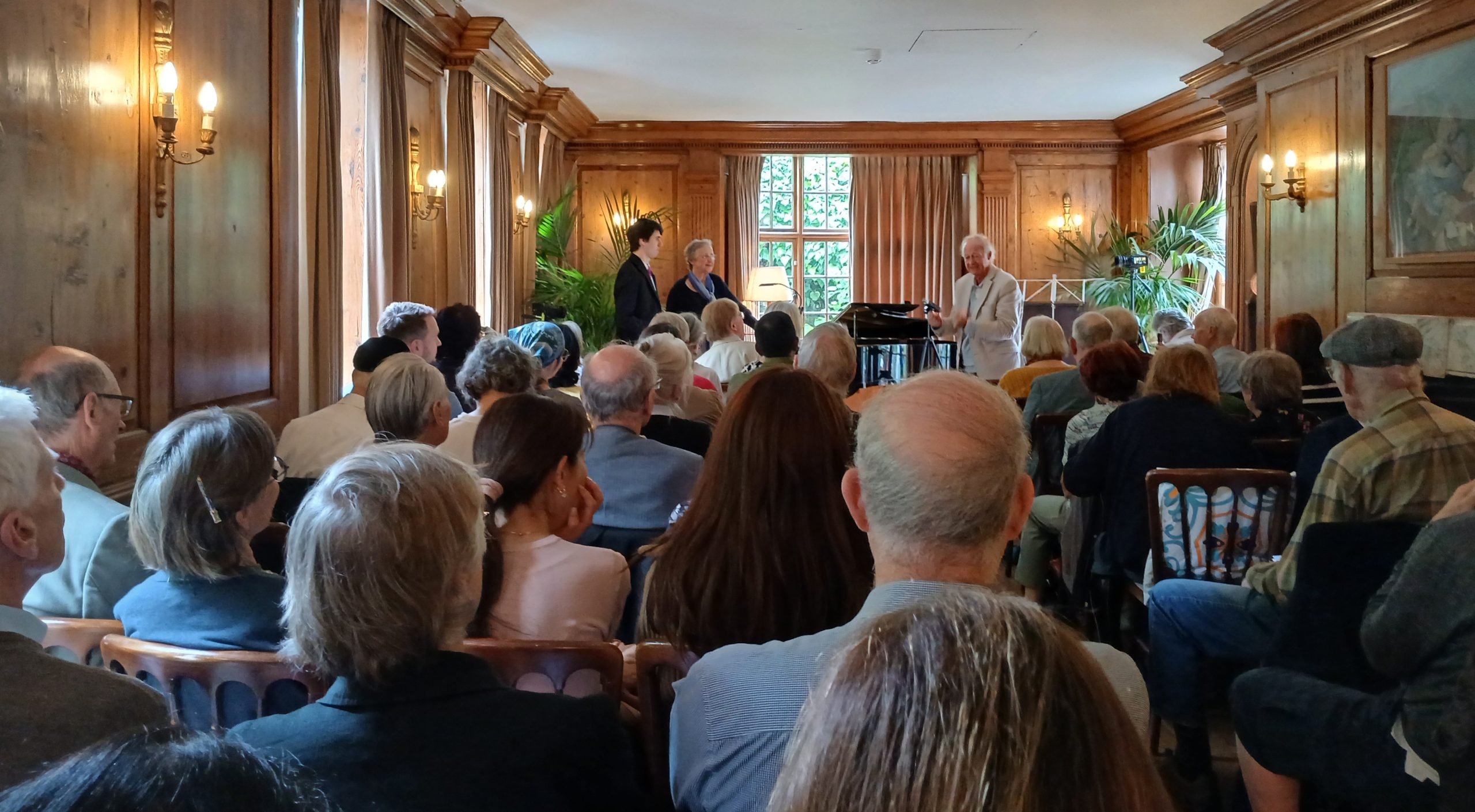
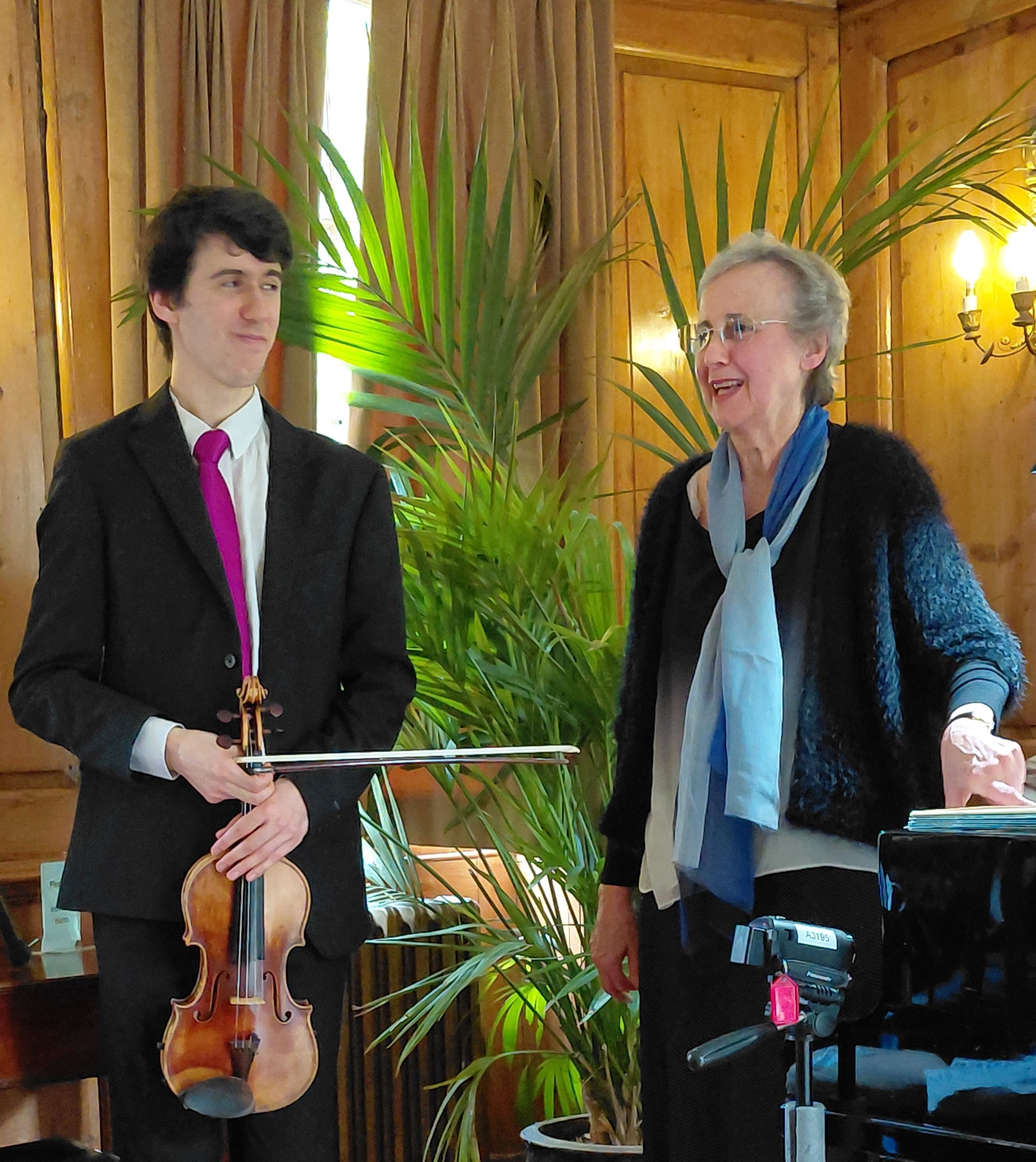
In June 2025, many of our members enjoyed an afternoon of delightful Sibelius melodies performed beautifully by Jenny Stern on piano and Emmanuel Bach on violin, courtesy of The UKSS. We were delighted that Emmanuel and the UKSS have delved deep into the extensive Sibelius archive and created an exciting new programme of his music for piano and for violin and piano. Jenny and Emmanuel returned to perform these works.
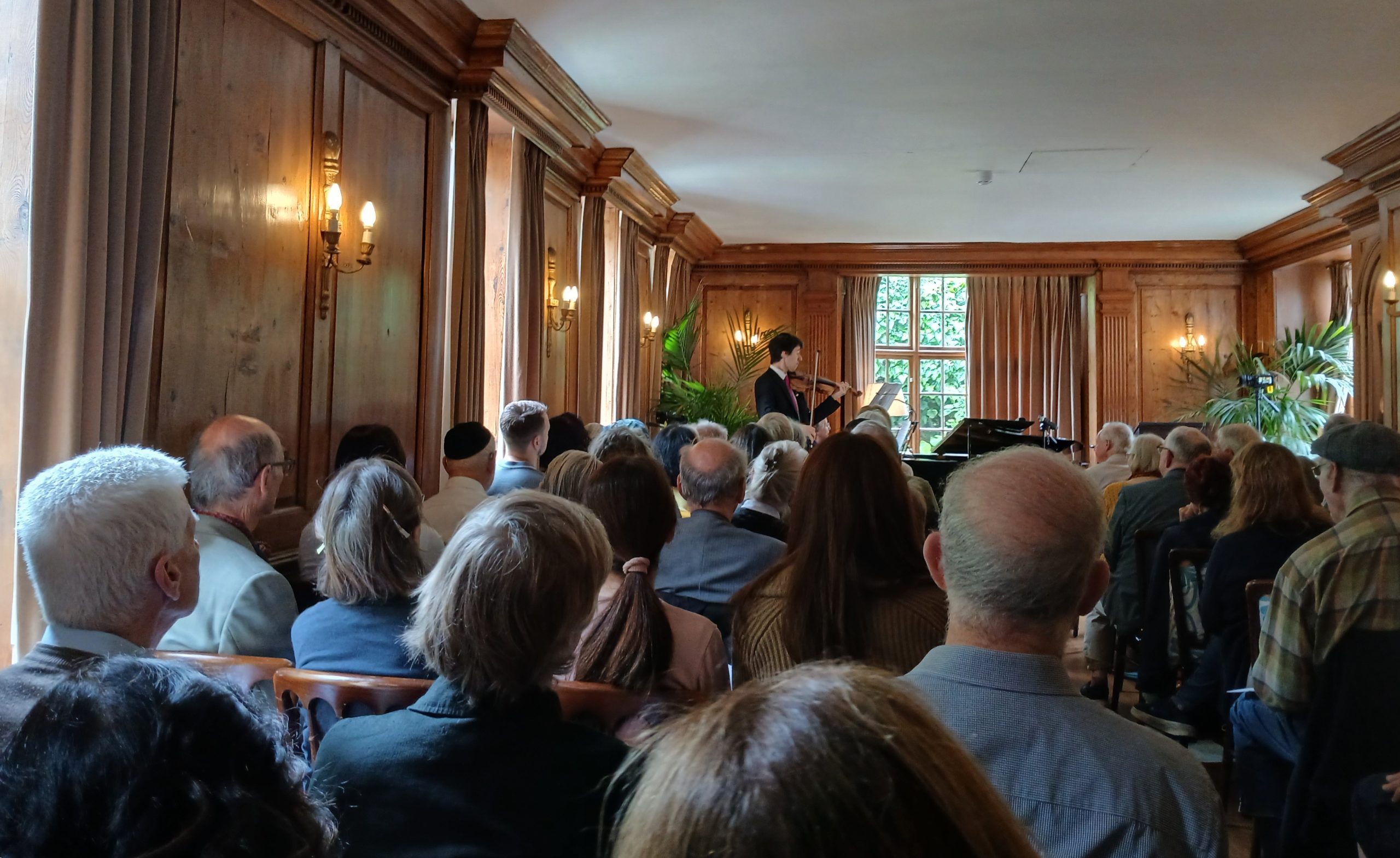
The programme included what is believed to be the UK premiere of Sibelius’s Sonata in A minor for Violin and Piano (1884). We also heard Sibelius’s Florestan Suite (1889), a meditative and lyrical work that tells the story of an unhappy man wandering around a forest falling in love with a water-nymph, but he cannot keep her and returns to his lonely wandering. We also heard Six Pieces Op 79 for Violin and Piano (c 1915-1917) and Five Pieces Op 81 for Violin and Piano (1915-1918).
On 19 June 2026, a rather warm day, we had a curated viewing of modern Finnish Graphic artwork at the British Museum with Jennifer (Jenny) Ramkalawon, Curator of Western Modern and Contemporary Graphic at the British Museum.
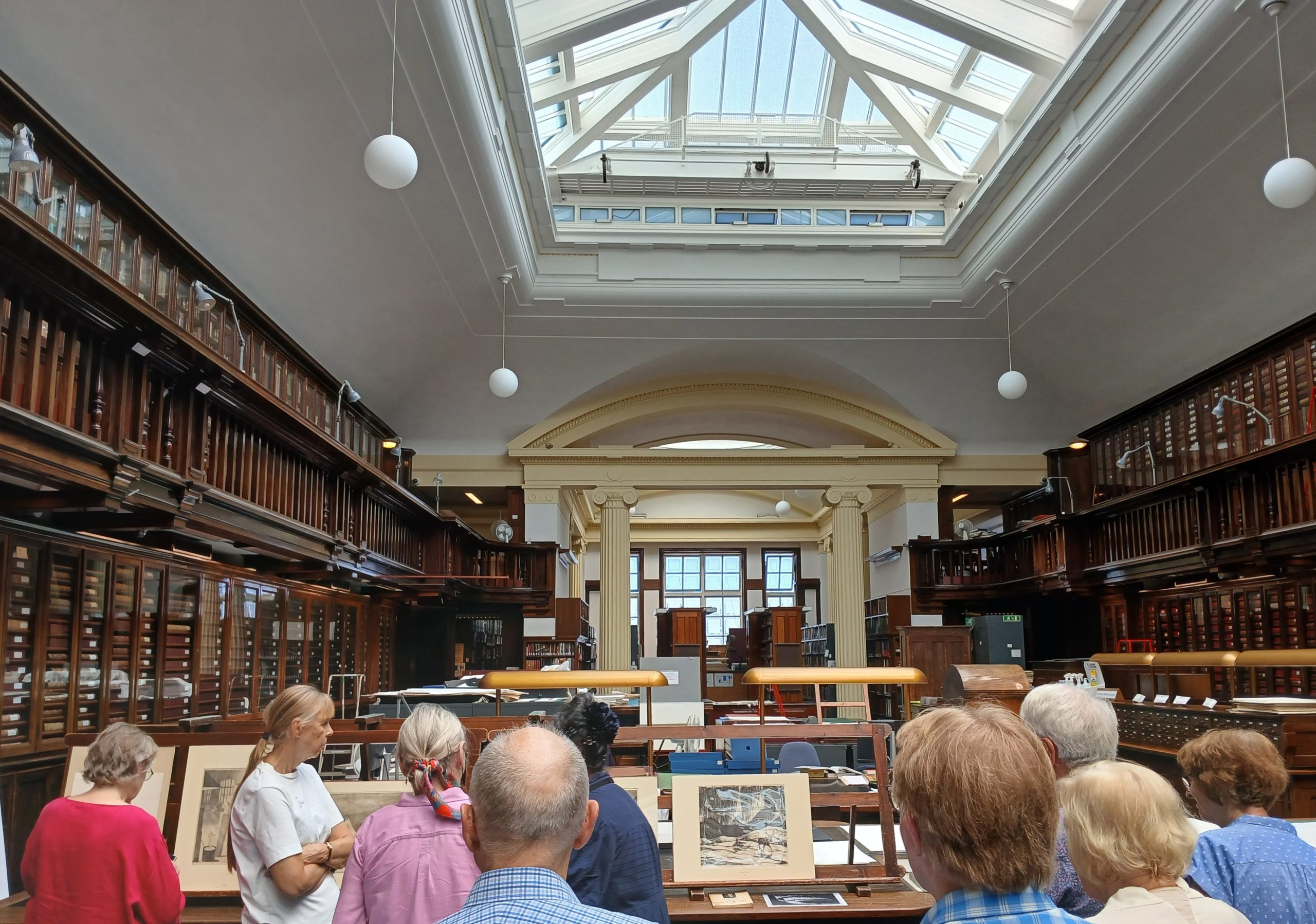
Jennifer Ramkalawon spent five years searching for the best Nordic works of the 20th century. Her search resulted in the acquisition of 400 graphic works for the British Museum; this, along with Jenny’s post, was funded by the AKO Foundation, a philanthropic organisation founded by a Norwegian multi-millionaire fund manager. To quote from the Financial Times’ interview with Jenny in October 2025, she “discovered a broad but largely unknown field that touches on the region’s social democratic ethos as well as its monumental landscape, a terrain of forests, jagged shores and crepuscular valleys that aligns perfectly with the grooves and grain of etchings and woodcuts”.
The result of her “voyage of discovery” was an exhibition of some 150 of the 400 collected works by 100 artists drawn from Norway, Sweden, Denmark, Finland and Iceland at the British Museum between October 2025 and March 2026. The exhibition has now been dismantled, but Jenny offered the A-FS a curated tour of Finnish works which are held in the onsite archive at the Museum.
We saw a print by Albert Edelfelt in 1905 showing an old man seemingly deep in thought with a fascinating display of light. We also saw prints by Lennart Segerstråle, Aukusti Tuhka (Aurora Borealis of 1917 was particularly impressive), Sam Vanni, Ernst Mether-Borgström, Juhana Blomstedt, Lea Ignatius and Outi Ikkala. For more photographs, please see our Instagram and Facebook pages.
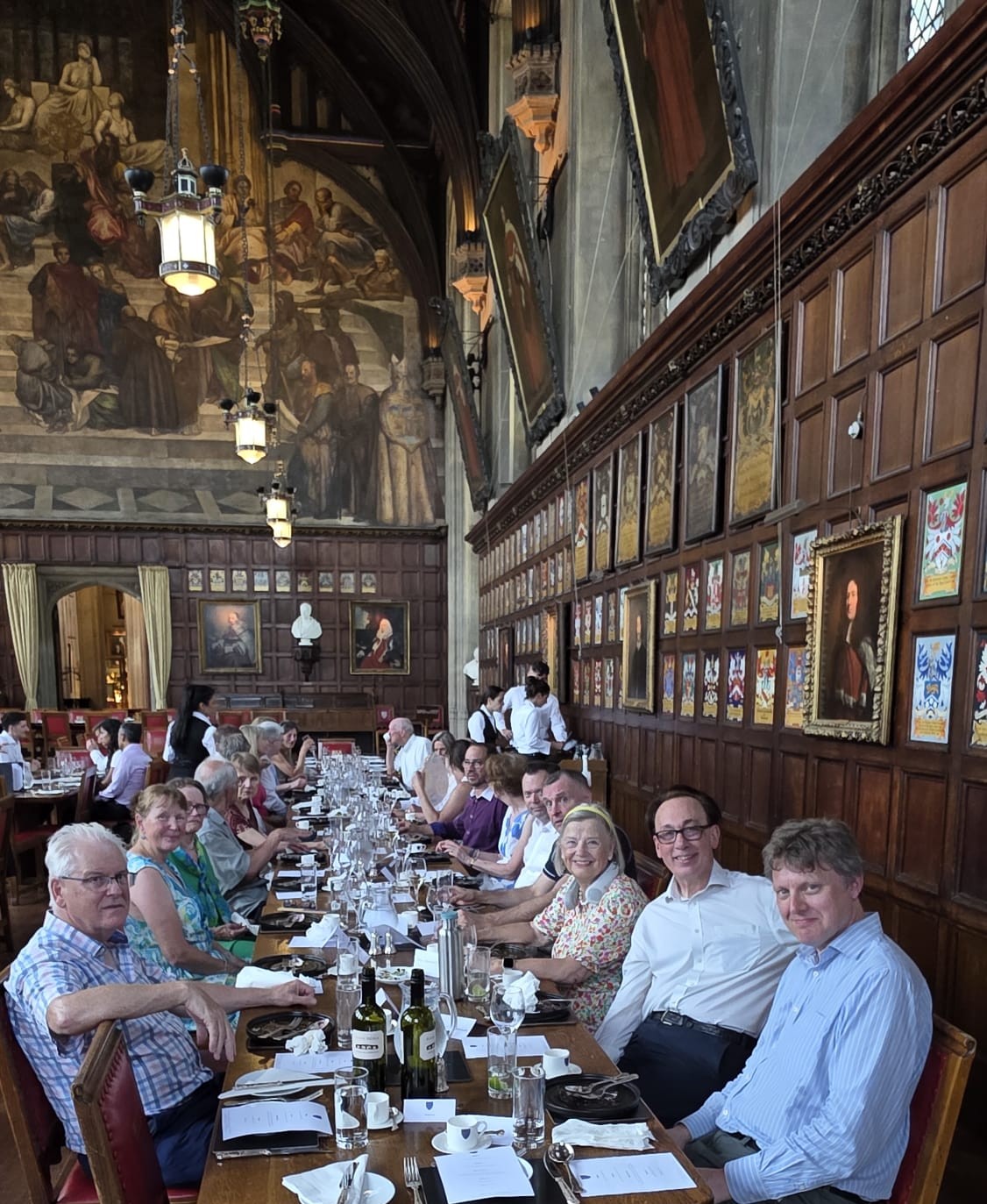
St John’s Day, 24 June 2026, turned out to be one of the hottest ever days in London. While the weather was not exactly Nordic, the third Anglo-Nordic Midsummer lunch went ahead and despite the heat and some last minute cancellations was a happy and convivial occasion.